

- Explore the role of machine learning in modern cloud architectures.
- Understand Google Cloud’s ML ecosystem and its integration with business solutions.
- Learn the fundamentals of the Google Professional Machine Learning Engineer certification.
- Identify key use cases for ML deployment on Google Cloud.
Google Cloud Certification Training Course
Google Professional Machine Learning Engineer Certification Training Course
The Google Professional Machine Learning Engineer Certification Training Course by Accumentum is designed to empower cloud professionals with the skills required to excel in designing, building, and deploying machine learning models using Google Cloud’s advanced ML technologies.
Course focus: Machine learning workflows on Google Cloud, including data preparation, model training, evaluation, and deployment, and the integration of AI solutions into production environments.
Course Overview
Design, build, and deploy machine learning models on Google Cloud.
The Google Professional Machine Learning Engineer Certification Training Course by Accumentum is designed to empower cloud professionals with the skills required to excel in designing, building, and deploying machine learning models using Google Cloud’s advanced ML technologies. This course is tailored for individuals looking to strengthen their expertise in machine learning and data engineering, with a focus on creating scalable, efficient, and robust ML systems on Google Cloud.
Participants will gain in-depth knowledge of machine learning workflows, including data preparation, model training, evaluation, and deployment, as well as the integration of AI solutions into production environments. The curriculum covers essential tools and practices such as TensorFlow, BigQuery ML, and AutoML, alongside strategies for optimizing model performance and ensuring scalability. Through hands-on labs and real-world case studies, learners will explore practical applications of Google Cloud’s ML capabilities, aligning technical proficiency with business objectives to deliver impactful AI-driven solutions.
This training is ideal for data scientists, engineers, and IT professionals aiming to elevate their careers by mastering Google Cloud’s machine learning methodologies. It equips candidates not only to succeed in the certification exam but also to drive innovation and efficiency in their organizations through cutting-edge machine learning expertise.
Course Objectives
Course objectives for the Google Professional Machine Learning Engineer Certification Training Course.
01
Design and Deploy ML Models
Develop proficiency in designing, training, evaluating, and deploying machine learning models on Google Cloud, ensuring scalable and efficient solutions tailored to real-world applications.
02
Master Google Cloud ML Tools
Gain hands-on expertise with tools like TensorFlow, BigQuery ML, and AutoML to build, optimize, and productionize AI models that align with business needs.
03
Optimize Model Performance
Learn techniques to enhance model accuracy, scalability, and reliability, including hyperparameter tuning, feature engineering, and performance monitoring in production environments.
04
Operationalize AI Solutions
Acquire skills to seamlessly deploy and manage machine learning solutions, enabling organizations to drive innovation and achieve operational excellence through AI-driven insights.
Who Should Attend
- Professionals seeking to advance their skills in designing and deploying machine learning models on Google Cloud for impactful, scalable AI solutions.
- Individuals aiming to deepen their expertise in building, optimizing, and productionizing ML systems using Google’s cutting-edge tools and methodologies.
- Those looking to expand their knowledge of machine learning integration within cloud environments to enhance operational efficiency and innovation.
- Individuals preparing for the Google Professional Machine Learning Engineer certification who want practical, hands-on experience to excel in the exam and their careers.
Prerequisites
- Familiarity with core machine learning concepts, such as supervised and unsupervised learning, model training, and evaluation metrics.
- Proficiency in Python, including experience with libraries like TensorFlow or scikit-learn, to effectively implement and customize ML models.
- Understanding of Google Cloud Platform basics, such as working with Compute Engine, Cloud Storage, or BigQuery, or completion of a foundational GCP course.
- Experience with data preprocessing, feature engineering, and querying datasets (e.g., using SQL), to prepare and manage data for machine learning workflows.
Pathway Map
The training course follows a ten-module Google Cloud machine learning path.
The curriculum moves from ML fundamentals on Google Cloud through data preparation, model design, training and tuning, deployment, pipeline automation, scalability, monitoring, advanced frameworks, and security and compliance.
1
Introduction to Machine Learning on Google Cloud
2
Data Preparation and Feature Engineering
3
Machine Learning Model Design
4
Training and Tuning ML Models
5
Model Deployment and Serving
6
Automation and Orchestration of ML Pipelines
7
Scalability and Performance Optimization
8
Monitoring and Maintaining ML Systems
9
Advanced Tools and Frameworks
10
Security and Compliance in ML Systems
Course Content
- Master techniques for cleaning, transforming, and structuring raw data for ML models.
- Use Google Cloud tools like Dataflow and BigQuery for efficient data preprocessing.
- Implement feature selection and engineering to enhance model performance.
- Handle missing data, outliers, and categorical variables effectively.
- Design supervised and unsupervised learning models tailored to specific problems.
- Explore model architectures, including deep learning and ensemble methods.
- Select appropriate algorithms based on data characteristics and business goals.
- Understand trade-offs between model complexity, accuracy, and scalability.
- Train models using Google Cloud’s AI Platform and Vertex AI.
- Apply hyperparameter tuning with tools like AI Platform HyperTune.
- Evaluate model performance using metrics like precision, recall, and AUC.
- Mitigate overfitting and underfitting through regularization and validation techniques.
- Deploy trained models to production using Vertex AI endpoints.
- Configure scalable, low-latency serving for real-time predictions.
- Implement batch and online prediction workflows for diverse use cases.
- Monitor deployed models for performance and drift in production environments.
- Build end-to-end ML pipelines with Vertex AI Pipelines and Kubeflow.
- Automate data ingestion, training, and deployment processes.
- Integrate continuous integration/continuous deployment (CI/CD) for ML workflows.
- Optimize pipeline efficiency to reduce latency and resource costs.
- Scale ML workloads using distributed training on Google Cloud infrastructure.
- Optimize resource usage with preemptible VMs and custom accelerators (e.g., TPUs).
- Implement caching and batching strategies for efficient inference.
- Troubleshoot and resolve performance bottlenecks in large-scale ML systems.
- Set up monitoring with Cloud Monitoring to track model health and metrics.
- Detect and address data drift, concept drift, and model degradation.
- Use logging and alerting to ensure system reliability and uptime.
- Establish retraining schedules to keep models current and accurate.
- Leverage TensorFlow Extended (TFX) for production-ready ML pipelines.
- Use AutoML to accelerate model development for rapid prototyping.
- Explore BigQuery ML for training models directly on structured data.
- Integrate custom models with Google Cloud’s pretrained APIs (e.g., Vision, NLP).
- Implement data encryption and access controls to protect sensitive information.
- Ensure compliance with regulations like GDPR and HIPAA in ML workflows.
- Use Identity and Access Management (IAM) to secure Google Cloud resources.
- Audit and validate ML systems for fairness, bias, and ethical considerations.
Course Features
Course features of the Google Professional Machine Learning Engineer Certification Training Course.
Interactive Learning
Engage with expert instructors and peers through training sessions, discussions, and practical exercises.
Comprehensive Study Materials
Access extensive resources, including e-books, video lectures, and practice exams.
Real-World Applications
Work on real-life case studies and scenarios to apply Machine Learning Engineering concepts.
Certification Preparation
Receive guidance and tips to successfully pass the Google Professional Machine Learning Engineer certification exam.
Certification Exam
Prepare for the Google Professional Machine Learning Engineer Certification Exam.
ML Engineer Exam Readiness
Accumentum’s training course prepares learners to design, build, and deploy scalable, efficient, and robust ML systems on Google Cloud.
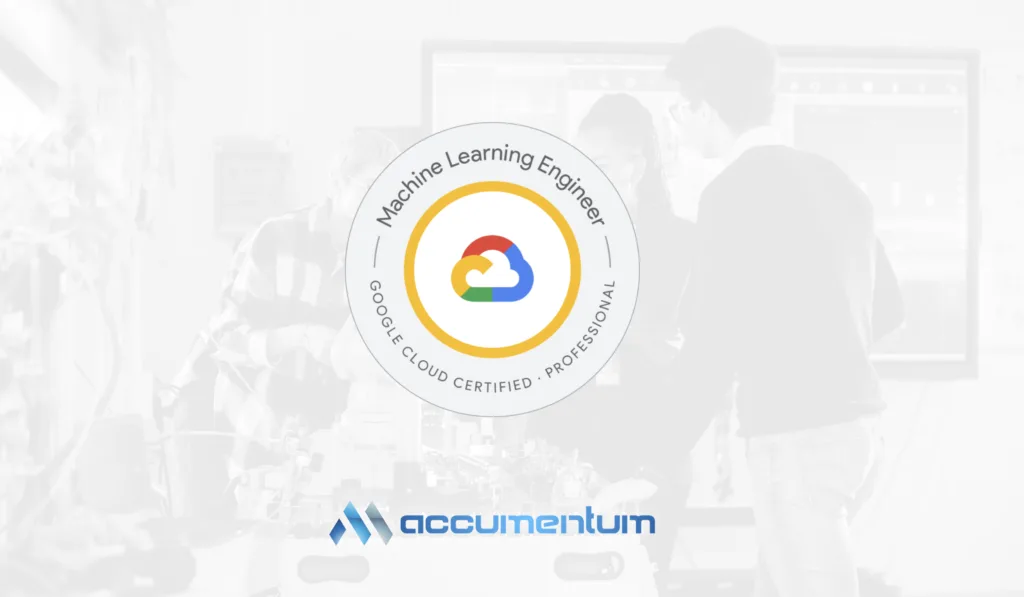
Upon completing the course, you will be thoroughly equipped to take the Google Professional Machine Learning Engineer Certification Exam. Earning this certification confirms your proficiency in machine learning practices, showcasing your ability to design, build, and deploy scalable, efficient, and robust ML systems on Google Cloud. This accomplishment will greatly enhance your career opportunities in machine learning and data engineering roles.
Exam Blueprint
Every section of the PMLE exam guide.
Google's Professional Machine Learning Engineer exam guide has 6 sections and 14 objectives. We've copied each one below in Google's own wording, with the approximate share of the exam it carries.
Google describes the role this way: "A Professional Machine Learning (ML) Engineer builds, evaluates, productionizes, and optimizes AI solutions using Google Cloud capabilities and knowledge of conventional ML approaches. The ML Engineer handles large, complex datasets and creates repeatable, reusable code. The ML Engineer designs and operationalizes AI solutions based on foundational models. The ML Engineer considers responsible AI practices and collaborates closely with other job roles to ensure the long-term success of AI-based applications. The ML Engineer has strong programming skills and experience with data platforms and distributed data processing tools. The ML Engineer is proficient in the areas of model architecture, data and ML pipeline creation, MLOps, and metrics interpretation. The ML Engineer is familiar with the foundational concepts of prompt and context engineering, application development, infrastructure management, data engineering, and data governance. The ML Engineer enables teams across the organization to use AI solutions. By training, retraining, deploying, scheduling, tuning, monitoring, and improving traditional and generative AI (gen AI) models, the ML Engineer designs and creates scalable, performant solutions."
Section 1: Architecting low-code AI solutions (about 13% of the exam)
1.1 Developing ML models using BigQuery ML or AutoML on Gemini Enterprise Agent Platform
- Building models in BigQuery ML or Agent Platform AutoML (for example classification, regression, forecasting, and clustering) based on the business problem
- Performing feature engineering or selection using BigQuery ML
- Generating predictions using BigQuery ML
- Training models using Agent Platform AutoML
- Fine-tuning Gemini models using BigQuery
1.2 Building AI solutions using Google Cloud AI APIs or foundational models
- Evaluating and selecting the appropriate model for a given task from Gemini Enterprise Agent Platform Model Garden
- Building applications using industry-specific APIs (for example Document AI API, Vision API, and Translate API)
- Building solutions and tuning models for specific use cases (for example Gemini, Imagen, Veo, and models as a service in Model Garden)
- Optimizing Gemini-based applications for cost, latency, and availability
Section 2: Collaborating within and across teams to manage data and models (about 16% of the exam)
2.1 Exploring and preprocessing data for ML
- Organizing and exploring different data types (for example tabular, text, and images) for efficient experimenting, training, and serving
- Choosing the right tool for data preprocessing based on scale and complexity (for example BigQuery [SQL], Dataflow, Apache Spark, and in-memory Python frameworks)
- Creating and consolidating features in Gemini Enterprise Agent Platform Feature Store
- Ensuring data privacy and handling sensitive information (for example personally identifiable information [PII])
2.2 Model prototyping using notebooks (for example Gemini Enterprise Agent Platform Workbench and Colab Enterprise)
- Applying collaboration and security best practices when setting up and running notebook environments
- Developing models in Agent Platform Workbench or Colab Enterprise notebooks using common frameworks (for example PyTorch, sklearn, and JAX)
- Using a variety of foundational and open-source models in Model Garden to create model prototypes in notebook environments
2.3 Tracking and running ML experiments
- Choosing the appropriate Google Cloud environment for development and experimentation (for example Experiments on Gemini Enterprise Agent Platform, Gemini Enterprise Agent Platform Pipelines, and Kubeflow Pipelines) given the framework
- Evaluating predictive and gen AI solutions (for example model evaluation metrics and LLM-as-a-judge)
- Tracking and comparing model artifacts, versions, and lineage (for example Experiments on Agent Platform and Gemini Enterprise Agent Platform ML Metadata)
Section 3: Scaling prototypes into ML models (about 21% of the exam)
3.1 Building models given the task considering cost, complexity, latency, and scalability
- Choosing the model type (for example ARIMA, DNN, and LLM)
- Choosing the product (for example Agent Platform AutoML, BigQuery ML, and Agent Platform Pipelines)
- Choosing the deployment strategy
- Modeling techniques given interpretability requirements
3.2 Training models
- Organizing training data (for example tabular, text, speech, images, and videos) on Google Cloud (for example Cloud Storage and BigQuery)
- Ingesting structured and unstructured data from various sources into training pipelines
- Model training using different software development kits (SDKs) (for example Agent Platform custom training, Kubeflow on Google Kubernetes Engine [GKE], Agent Platform AutoML, and Tabular Workflows) and organizing training on Google Cloud
- Troubleshooting ML model training failures
- Hyperparameter tuning
- Fine-tuning foundational models from Agent Platform and Model Garden and when tuning should be considered
3.3 Choosing appropriate hardware for training
- Evaluation of compute and accelerator options (for example CPU, GPU, and TPU)
- Understanding the options for distributed training on GPUs and TPUs using data and model parallelism strategies
Section 4: Serving and scaling models (about 20% of the exam)
4.1 Serving models
- Deploying models for batch and online inference using appropriate services (for example Agent Platform, Model Garden, Cloud Run, and GKE)
- Packaging and serving models from different frameworks (for example PyTorch and XGBoost) using prebuilt and custom containers
- Organizing and versioning models in Gemini Enterprise Agent Platform Model Registry
- Implementing model rollout strategies (for example A /B testing and canary deployments) to compare model versions
- Developing solutions for inference preprocessing and postprocessing
4.2 Scaling online model serving
- Managing and serving features using Agent Platform Feature Store
- Deploying models to public and private endpoints
- Choosing appropriate hardware (for example CPU, GPU, TPU, and edge)
- Scaling the serving backend based on the throughput (for example Gemini Enterprise Agent Platform Inference and containerized serving)
- Tuning ML models for training and serving in production
Section 5: Automating and orchestrating ML pipelines (about 18% of the exam)
5.1 Developing end-to-end ML pipelines
- Validating data and models
- Building and orchestrating pipelines using managed or unmanaged services and from templates or custom solutions (for example Agent Platform Pipelines, Managed Service for Apache Airflow, and Ray on Gemini Enterprise Agent Platform)
- Ensuring consistent data preprocessing between training and serving
5.2 Automating model retraining
- Determining an appropriate retraining policy
- Deploying models in continuous integration, continuous delivery, and continuous training (CI/CD/CT) pipelines (for example Cloud Build)
Section 6: Monitoring AI solutions (about 13% of the exam)
6.1 Identifying risks to AI solutions
- Building secure AI systems by protecting against unintentional exploitation and leaks of data or models (for example data exfiltration, malicious prompting, and sharing sensitive data with LLMs) using the appropriate security tool (for example Regex, safety filters, and Model Armor)
- Aligning with responsible AI practices (for example monitoring for bias)
- Model explainability on Agent Platform (for example Agent Platform Inference)
6.2 Monitoring, testing, and troubleshooting AI solutions
- Configuring and using Model Monitoring on Gemini Enterprise Agent Platform to establish continuous evaluation metrics for production models
- Monitoring for common issues (for example training-serving skew, data drift, concept drift, and feature attribution drift)
- Monitoring, testing, and evaluating gen AI solutions
Who It Is For
Is PMLE the right fit for you?
It suits ML engineers, data scientists moving into production work, MLOps engineers and AI application developers. Google notes that the exam doesn't directly assess coding skills, and that if you have a minimum proficiency in Python and SQL, you should be able to interpret any questions with code snippets.
Google lists no prerequisites. Its recommended experience is 3+ years of industry experience including 1 or more years designing and managing solutions using Google Cloud.
Exam Format
How the PMLE exam works.
Exam details
- Length: 2 hours
- Registration fee: $200 (plus tax where applicable)
- Languages: English and Japanese
- Format: 50 to 60 multiple choice and multiple select questions
- Delivery: online proctored from a remote location, or onsite at a testing center
- Prerequisites: none
Google doesn't publish a passing score on the certification page, so we don't guess at one. What we can tell you is how the questions behave. Multiple select items ask for more than one correct answer. In our experience, many questions are short scenarios where two options look reasonable and only one fits every requirement in the prompt.
That's why we train you to read for the constraint first. Cost, latency, compliance, operational effort and time to deliver are the words that usually decide the answer.
Study Plan
How we prepare you for PMLE.
We start with Section 1, Architecting low-code AI solutions. It's about 13% of the exam, so we work its 2 objectives in hands-on labs and short scenario drills.
Next we cover Section 2, Collaborating within and across teams to manage data and models. It's about 16% of the exam, so we work its 3 objectives in hands-on labs and short scenario drills.
Then we move to Section 3, Scaling prototypes into ML models. It's about 21% of the exam, so we work its 3 objectives in hands-on labs and short scenario drills.
After that comes Section 4, Serving and scaling models. It's about 20% of the exam, so we work its 2 objectives in hands-on labs and short scenario drills.
We follow with Section 5, Automating and orchestrating ML pipelines. It's about 18% of the exam, so we work its 2 objectives in hands-on labs and short scenario drills.
We wrap up with Section 6, Monitoring AI solutions. It's about 13% of the exam, so we work its 2 objectives in hands-on labs and short scenario drills.
Section 3 carries the most weight, so it gets the most review time. In the last week we run timed practice at the real pace, revisit your weakest sections and reread the exam guide line by line. Google also publishes sample questions and a learning path on the certification page, and we use both.
Exam Policies
Retakes and renewal for PMLE.
For professional exams, Google allows a maximum of four attempts in a two year period. If you don't pass, you can take it again after 14 days. After a second miss you wait 60 days, and after a third you wait 365 days before a fourth attempt.
Every attempt counts toward that limit, whatever the language or delivery method, and payment is required each time you register.
Professional certifications can be renewed starting 60 days before the expiration date, and Google's terms say early attempts may be rejected and the exam fee forfeited.
Online proctored exams run through Pearson. Google notes that if a session can't be restarted after you've seen exam content, the attempt counts and the retake policy applies, so check your system and connection ahead of time.
Career Outlook
Where PMLE can take you.
PMLE is aimed at machine learning engineers. BLS doesn't track cloud roles separately, so we use the closest occupation as a reference.
For a sense of pay, BLS puts the May 2025 median annual wage for software developers, quality assurance analysts and testers at $134,040. That figure is a national midpoint. Where you live, how long you have been in the field and who you work for all move the number. Source: BLS Occupational Outlook Handbook.
Funding
Ways to pay for PMLE training.
Paying on your own? PMLE prep is eligible for PathPay, our monthly payment plan. Terms of 3, 4 and 6 months carry no added fee. 9, 12 and 18 month terms add 5%, 10% and 15%. Course access opens when your first payment clears.
Our funding page lists every other way to pay, and you can always talk with us or email info@accumentum.net before you enroll.
Frequently Asked Questions
Understand how Accumentum’s Google Professional Machine Learning Engineer Certification Training Course supports certification readiness, course delivery, and career advancement.
It is a Google Cloud certification that confirms your proficiency in machine learning practices, showcasing your ability to design, build, and deploy scalable, efficient, and robust ML systems on Google Cloud.
Professionals advancing their skills in designing and deploying ML models on Google Cloud, individuals productionizing ML systems, those integrating machine learning within cloud environments, and candidates preparing for the certification.
Familiarity with core machine learning concepts, proficiency in Python with libraries like TensorFlow or scikit-learn, an understanding of Google Cloud Platform basics, and experience with data preprocessing, feature engineering, and querying datasets.
The course covers TensorFlow, TensorFlow Extended (TFX), BigQuery ML, AutoML, Vertex AI, Vertex AI Pipelines, Kubeflow, Dataflow, BigQuery, AI Platform HyperTune, and Google Cloud’s pretrained APIs such as Vision and NLP.
Ten modules cover ML on Google Cloud, data preparation and feature engineering, model design, training and tuning, deployment and serving, pipeline automation, scalability and performance optimization, monitoring and maintenance, advanced tools, and security and compliance.
Yes. Through hands-on labs and real-world case studies, learners explore practical applications of Google Cloud’s ML capabilities.
Modules cover deploying models to Vertex AI endpoints, batch and online prediction workflows, monitoring for drift, retraining schedules, and CI/CD for ML workflows.
Yes. A dedicated module covers data encryption and access controls, compliance with regulations like GDPR and HIPAA, IAM, and auditing ML systems for fairness, bias, and ethical considerations.
Earning the certification greatly enhances career opportunities in machine learning and data engineering roles and equips you to drive innovation and efficiency in your organization.
Join the Google Professional Machine Learning Engineer Certification Training Course at Accumentum by visiting Accumentum’s registration page linked on this page.
Google lists 2 hours for 50 to 60 multiple choice and multiple select questions.
Google lists a registration fee of $200, plus tax where applicable.
Google offers it in English and Japanese.
Yes. You can take an online proctored exam from a remote location or an onsite proctored exam at a testing center.
For professional exams, Google allows a maximum of four attempts in a two year period. If you don't pass, you can take it again after 14 days. After a second miss you wait 60 days, and after a third you wait 365 days before a fourth attempt.
Professional certifications can be renewed starting 60 days before the expiration date, and Google's terms say early attempts may be rejected and the exam fee forfeited.
Yes. PMLE prep is eligible for PathPay. Terms of 3, 4 and 6 months add no fee, and longer terms add 5% to 15%.
Enrollment
Enroll in the Google Professional Machine Learning Engineer Certification Training Course at Accumentum.
Join the Google Professional Machine Learning Engineer Certification Training Course at Accumentum to launch your path toward becoming a certified machine learning expert on Google Cloud. For more information and to register, visit Accumentum’s enrollment page linked below.
Build production-ready machine learning on Google Cloud.
Prepare for the Google Professional Machine Learning Engineer Certification Exam and learn to design, build, and deploy scalable, efficient, and robust ML systems on Google Cloud.