
- Understanding cloud computing concepts
- Benefits of cloud computing
- Types of cloud models (public, private, hybrid)
- Types of cloud services (IaaS, PaaS, SaaS)
Microsoft Certification Training Course
Microsoft Azure Fundamentals Training Course AZ-900
Gain a foundational understanding of Microsoft Azure with Accumentum’s Microsoft Azure Fundamentals Training Course (AZ-900), a comprehensive introduction to cloud services and how they are provided with Microsoft Azure.
Course focus: Core Azure concepts, services, solutions, and management tools, as well as general cloud computing principles.
Course Overview
Build a foundational understanding of Microsoft Azure and cloud computing.
The Microsoft Azure Fundamentals Training Course (AZ-900) at Accumentum is designed for individuals looking to gain a foundational understanding of Microsoft Azure. This course provides a comprehensive introduction to cloud services and how they are provided with Microsoft Azure. It covers core Azure concepts, services, solutions, and management tools, as well as general cloud computing principles, making it an ideal starting point for those new to Azure and cloud computing.
Course Objectives
Course objectives for the Microsoft Azure Fundamentals Training Course (AZ-900).
01
Understand Cloud and Azure Basics
Understand the basics of cloud computing and Azure.
02
Learn Core Azure Services
Learn about core Azure services and solutions.
03
Know Pricing, SLA, and Lifecycle
Gain insights into Azure pricing, SLA, and lifecycle.
04
Prepare for the AZ-900 Exam
Familiarize with the fundamentals of cloud security, compliance, and trust, and prepare for the Microsoft Certified: Azure Fundamentals certification exam (AZ-900).
Who Should Attend
- Individuals new to cloud computing and interested in learning about Microsoft Azure.
- IT professionals seeking to understand the basics of cloud services and how Azure can benefit their organization.
- Business stakeholders and technical decision-makers exploring Azure as a cloud solution.
- Anyone preparing for the Microsoft Certified: Azure Fundamentals certification exam.
Prerequisites
- There are no specific prerequisites for this course. It is suitable for individuals with no technical background as well as those with some IT experience who want to learn about Azure.
Pathway Map
The AZ-900 training course follows the Azure fundamentals learning path.
The curriculum moves from cloud computing concepts through core Azure services, pricing and support, security and compliance, management tools, and Azure solutions.
Course Content
- Overview of Azure architecture and services
- Core Azure services (Compute, Networking, Storage, Databases)
- Azure Marketplace
- Azure pricing and cost management
- Azure Service Level Agreements (SLAs)
- Azure support options
- Securing network connectivity in Azure
- Core Azure identity services
- Azure governance methodologies
- Monitoring and reporting in Azure
- Privacy, compliance, and data protection standards
- Azure Portal
- Azure PowerShell and Azure CLI
- Azure Resource Manager (ARM) templates
- Azure mobile app
- Internet of Things (IoT) on Azure
- AI and machine learning services
- Serverless computing in Azure
- DevOps solutions on Azure
Course Features
Course features of the Microsoft Azure Fundamentals Training Course (AZ-900).
Interactive Learning
Participate in training sessions, discussions, and hands-on labs with experienced instructors.
Practical Scenarios
Engage in real-world exercises and case studies to apply your knowledge.
Comprehensive Study Materials
Access extensive resources, including e-books, video lectures, and practice exams.
Certification Preparation
Receive guidance and tips to successfully pass the Microsoft Certified: Azure Fundamentals certification exam
Certification Exam
Prepare for the Microsoft Certified: Azure Fundamentals certification exam (AZ-900).
AZ-900 Exam Readiness
Accumentum’s AZ-900 Training Course prepares learners to demonstrate foundational knowledge of cloud concepts, core Azure services, pricing and support, security, compliance, and Azure management tools.
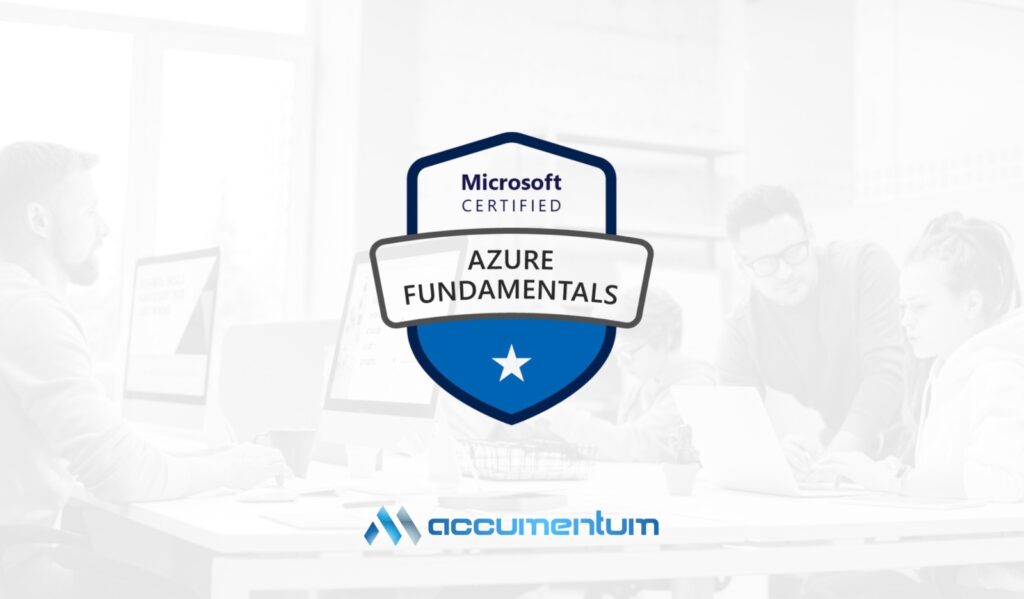
Upon completing the course, you will be prepared to take the Microsoft Certified: Azure Fundamentals certification exam (AZ-900). This certification validates your foundational knowledge of Azure and cloud services, enhancing your career opportunities in the cloud computing domain.
Skills Measured
What Microsoft says AZ-900 measures.
Microsoft lists the skills measured for Exam AZ-900 as of July 20, 2026. Here are all 3 domains, 11 skill groups and 57 tasks in Microsoft's own wording. Our course maps a lesson or lab to each one.
Describe cloud computing
Part of Describe cloud concepts (25 to 30%)
- Define cloud computing
- Describe the shared responsibility model
- Define cloud models, including public, private, and hybrid
- Identify appropriate use cases for each cloud model
- Describe the consumption-based model
- Compare cloud pricing models
- Describe serverless
Describe the benefits of using cloud services
Part of Describe cloud concepts (25 to 30%)
- Describe the benefits of high availability and scalability in the cloud
- Describe the benefits of reliability and predictability in the cloud
- Describe the benefits of security and governance in the cloud
- Describe the benefits of manageability in the cloud
Describe cloud service types
Part of Describe cloud concepts (25 to 30%)
- Describe infrastructure as a service (IaaS)
- Describe platform as a service (PaaS)
- Describe software as a service (SaaS)
- Identify appropriate use cases for each cloud service type (IaaS, PaaS, and SaaS)
Describe the core architectural components of Azure
Part of Describe Azure architecture and services (35 to 40%)
- Describe Azure regions, region pairs, and sovereign regions
- Describe availability zones
- Describe Azure datacenters
- Describe Azure resources and resource groups
- Describe subscriptions
- Describe management groups
- Describe the hierarchy of resource groups, subscriptions, and management groups
Describe Azure compute and networking services
Part of Describe Azure architecture and services (35 to 40%)
- Compare compute types, including containers, virtual machines, and functions
- Describe virtual machine options, including Azure virtual machines, Azure Virtual Machine Scale Sets, availability sets, and Azure Virtual Desktop
- Describe the resources required for virtual machines
- Describe application hosting options, including web apps, containers, and virtual machines
- Describe virtual networking, including the purpose of Azure virtual networks, subnets, peering, Azure DNS, Azure VPN Gateway, and ExpressRoute
- Define public and private endpoints
Describe Azure storage services
Part of Describe Azure architecture and services (35 to 40%)
- Compare Azure Storage services
- Describe storage tiers
- Describe redundancy options
- Describe storage account options and storage types
- Identify options for moving files, including AzCopy, Azure Storage Explorer, and Azure File Sync
- Describe migration options, including Azure Migrate and Azure Data Box
Describe Azure identity, access, and security
Part of Describe Azure architecture and services (35 to 40%)
- Describe directory services in Azure, including Microsoft Entra ID and Microsoft Entra Domain Services
- Describe authentication methods in Azure, including single sign-on (SSO), multifactor authentication (MFA), and passwordless
- Describe external identities in Azure
- Describe Microsoft Entra Conditional Access
- Describe Azure role-based access control (RBAC)
- Describe the concept of Zero Trust
- Describe the purpose of the defense-in-depth model
- Describe the purpose of Microsoft Defender for Cloud
Describe cost management in Azure
Part of Describe Azure management and governance (30 to 35%)
- Describe factors that can affect costs in Azure
- Explore the pricing calculator
- Describe cost management capabilities in Azure
- Describe the purpose of tags
Describe features and tools in Azure for governance and compliance
Part of Describe Azure management and governance (30 to 35%)
- Describe the purpose of Microsoft Purview in Azure
- Describe the purpose of Azure Policy
- Describe the purpose of resource locks
Describe features and tools for managing and deploying Azure resources
Part of Describe Azure management and governance (30 to 35%)
- Describe the Azure portal
- Describe Azure Cloud Shell, Azure CLI, and Azure PowerShell
- Describe the purpose of Azure Arc
- Describe infrastructure as code (IaC)
- Describe Azure Resource Manager (ARM) and ARM templates
Describe monitoring tools in Azure
Part of Describe Azure management and governance (30 to 35%)
- Describe the purpose of Azure Advisor
- Describe Azure Service Health
- Describe Azure Monitor, including Log Analytics, Azure Monitor alerts, and Azure Monitor Application Insights
Study Plan
How we suggest you work through AZ-900.
We begin with cloud concepts. Shared responsibility, public, private and hybrid models, consumption pricing and the benefits of cloud services come first, because every later topic builds on them.
Azure architecture and services carry the most weight at 35 to 40 percent. We tour regions and availability zones, compute, networking, storage, and identity, with short demos in the Azure portal so each service has a picture attached to it.
Management and governance come next. Cost management, Azure Policy, resource locks, the tools for deploying and managing resources, and monitoring tools each get time.
The last session is review. We walk the full skills outline, work practice questions in class, and show you the exam sandbox.
Exam Policies
Scoring, renewal and test day for AZ-900.
AZ-900 leads to Microsoft Certified: Azure Fundamentals. Microsoft requires a score of 700 or greater to pass.
Microsoft notes that the bullets under each skill show how a skill is assessed, and related topics may also be covered. Most questions cover features that are generally available, but the exam can include Preview features if they are commonly used.
Before test day you can try the exam sandbox to see the exam interface. If you use assistive devices or need extra time, Microsoft lets you request an accommodation. If the exam is not offered in your preferred language, you can request an extra 30 minutes.
Microsoft fundamentals certifications do not expire, so once you pass, the credential stays on your transcript.
Career Outlook
Where AZ-900 can take you.
AZ-900 is the common first step into Microsoft cloud work. It helps help desk staff, new IT hires, students, sales and project staff and managers who work with cloud teams. On its own it does not lead to one job title, but it gives you the vocabulary to move into AZ-104, AI-901, SC-900 and other role based paths.
For a sense of pay, BLS puts the May 2025 median annual wage for computer occupations as a group at $109,470. That figure is a national midpoint. Where you live, how long you have been in the field and who you work for all move the number. Source: BLS Occupational Outlook Handbook.
Funding and PathPay
Ways to pay for AZ-900 training.
Accumentum is an Army CA and Air Force COOL Approved Vendor. If you're serving, start with your education center and read our Army CA and Air Force COOL pages for the steps. We'll help you line up the course with your request.
Paying on your own? AZ-900 prep is eligible for PathPay, our monthly payment plan. Terms of 3, 4 and 6 months carry no added fee. 9, 12 and 18 month terms add 5%, 10% and 15%. Course access opens when your first payment clears.
Our funding page has every other option, and you can always talk with us or email info@accumentum.net before you enroll.
Frequently Asked Questions
Understand how Accumentum’s Microsoft Azure Fundamentals Training Course (AZ-900) supports certification readiness, course delivery, and career advancement.
The Microsoft Certified: Azure Fundamentals certification, earned by passing exam AZ-900, validates foundational knowledge of cloud concepts and Microsoft Azure. Accumentum’s Microsoft Azure Fundamentals Training Course (AZ-900) provides a comprehensive introduction to cloud services and how they are provided with Microsoft Azure, covering core Azure concepts, services, solutions, and management tools, as well as general cloud computing principles.
The course is designed for individuals new to cloud computing and interested in learning about Microsoft Azure, IT professionals seeking to understand the basics of cloud services and how Azure can benefit their organization, business stakeholders and technical decision-makers exploring Azure as a cloud solution, and anyone preparing for the Microsoft Certified: Azure Fundamentals certification exam.
There are no specific prerequisites for this course. It is suitable for individuals with no technical background as well as those with some IT experience who want to learn about Azure.
The curriculum covers Introduction to Cloud Computing, Core Azure Services, Azure Pricing and Support, Azure Security, Privacy, Compliance, and Trust, Azure Management Tools, and Azure Solutions and Management, including cloud models, IaaS/PaaS/SaaS, SLAs, identity services, governance, the Azure Portal, PowerShell and CLI, ARM templates, IoT, AI and machine learning, serverless computing, and DevOps on Azure.
Yes. A dedicated module covers Azure pricing and cost management, Azure Service Level Agreements (SLAs), and Azure support options, giving you insights into Azure pricing, SLA, and lifecycle.
Yes. The Azure Security, Privacy, Compliance, and Trust module covers securing network connectivity in Azure, core Azure identity services, Azure governance methodologies, monitoring and reporting in Azure, and privacy, compliance, and data protection standards.
The course features interactive learning, where you participate in training sessions, discussions, and hands-on labs with experienced instructors, plus practical scenarios that let you engage in real-world exercises and case studies to apply your knowledge.
You receive comprehensive study materials with access to extensive resources, including e-books, video lectures, and practice exams, along with certification preparation guidance and tips to successfully pass the Microsoft Certified: Azure Fundamentals certification exam.
This certification validates your foundational knowledge of Azure and cloud services, enhancing your career opportunities in the cloud computing domain and providing a strong starting point for role-based Azure certifications such as Azure Administrator Associate.
Enroll in the Microsoft Azure Fundamentals Training Course (AZ-900) at Accumentum and start your journey into the world of cloud computing. For more information and to register, visit Accumentum’s course registration page linked below.
Microsoft requires a score of 700 or greater to pass.
Microsoft lists these domains:
- Describe cloud concepts, 25 to 30%
- Describe Azure architecture and services, 35 to 40%
- Describe Azure management and governance, 30 to 35%
Describe Azure architecture and services is the largest at 35 to 40%. We give it the most lab time.
Microsoft lists 57 tasks across 11 skill groups as of July 20, 2026. Our course covers all of them.
Microsoft fundamentals certifications do not expire, so once you pass, the credential stays on your transcript.
Yes. Microsoft offers an exam sandbox that shows you the exam interface and question types.
Accumentum is an Army CA and Air Force COOL Approved Vendor. Start with your education center, and we'll help you with the rest.
Microsoft says most questions cover generally available features, but Preview features can appear if they are commonly used.
Yes. AZ-900 prep is eligible for PathPay. Terms of 3, 4 and 6 months add no fee, and longer terms add 5% to 15%.
Enrollment
Enroll in the Microsoft Azure Fundamentals Training Course (AZ-900) at Accumentum.
Enroll in the Microsoft Azure Fundamentals Training Course (AZ-900) at Accumentum and start your journey into the world of cloud computing. For more information and to register, visit Accumentum’s course registration page below.
Start your Azure journey with the AZ-900 training course.
Prepare for the Microsoft Certified: Azure Fundamentals certification exam, build core cloud knowledge, and learn how Azure services, pricing, security, and management tools work together.